The story at a glance
An accessible route isn’t always a journey someone feels able to take.
Working in partnership with Woven by Toyota, our team studied how older adults navigate New York transit. Interviews, observations and journey mapping pointed beyond physical access to an equally important problem: uncertainty before and during a trip.
Design research and service concepts · Companion app and public-facing campaign proposals
- 2
- boroughs observed
- Compass
- companion app concept
- Look Out
- public-facing campaign
How we got here
A trip can become difficult before someone leaves home
Our team studied older adults' journeys through interviews, observations in subway stations across two boroughs, secondary research and journey mapping. Stairs and elevators mattered, but so did crowds, unclear announcements and the possibility of an unexpected transfer. Margaret, our synthesized persona, helped connect these moments into a journey. The research kept returning to a simple tension: information about a route doesn't necessarily make someone confident they can complete it.
Research changed the framing · 01
Look at the trip before it begins.
A route could be marked as accessible while the traveler still worried about crowds, disruptions or having to call someone for help.
Planning often meant anticipating elevators, crowds, transfers and what might go wrong. We reframed the experience around preparation and recovery, not simply showing another route on a map.
A product response · 02
Support a rider without turning care into surveillance.
Family and neighbors often help when a trip changes. But making that help available shouldn't mean giving up independence.
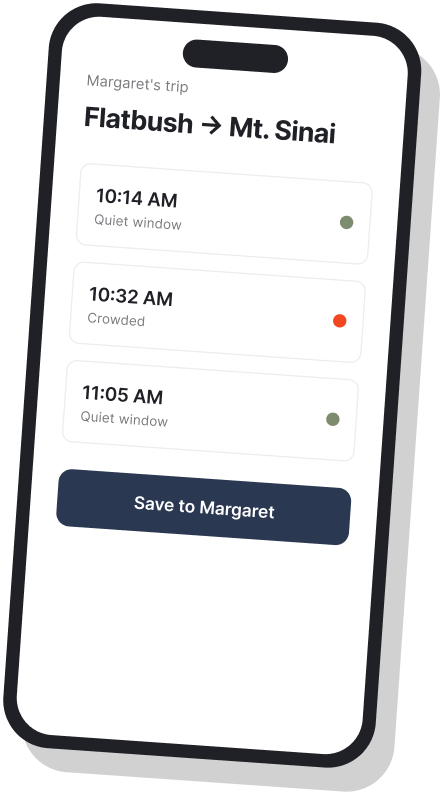
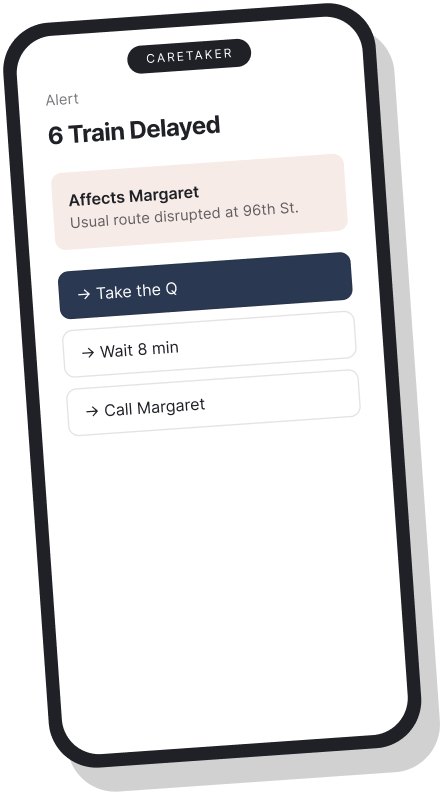
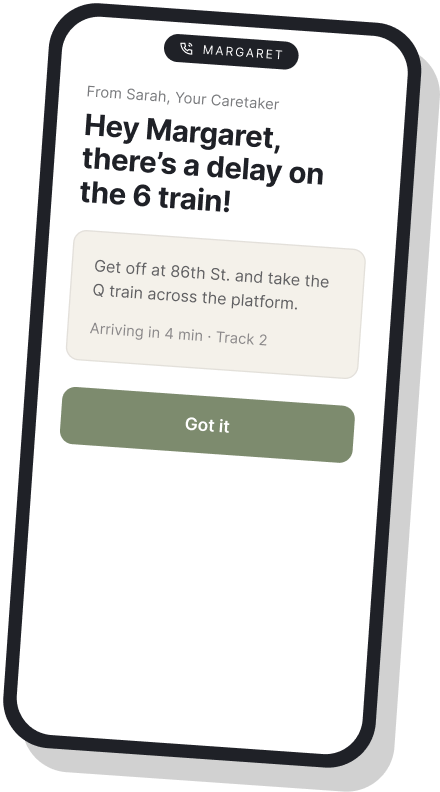
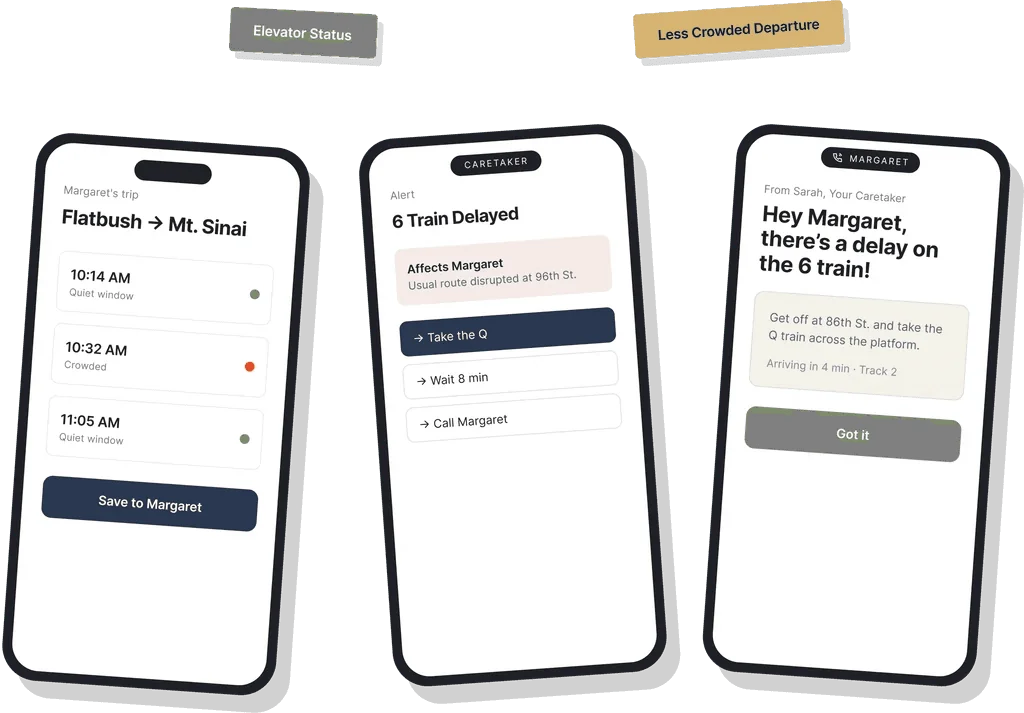
Compass is a companion concept for familiar trips, accessible routes and disruption alerts. A caretaker can help with the next step when plans change, rather than tracking or directing the whole journey.
Compass companion app concept
A service response · 03
Not every transit problem belongs in an app.
More alerts and route details can't solve the social experience of a crowded platform.
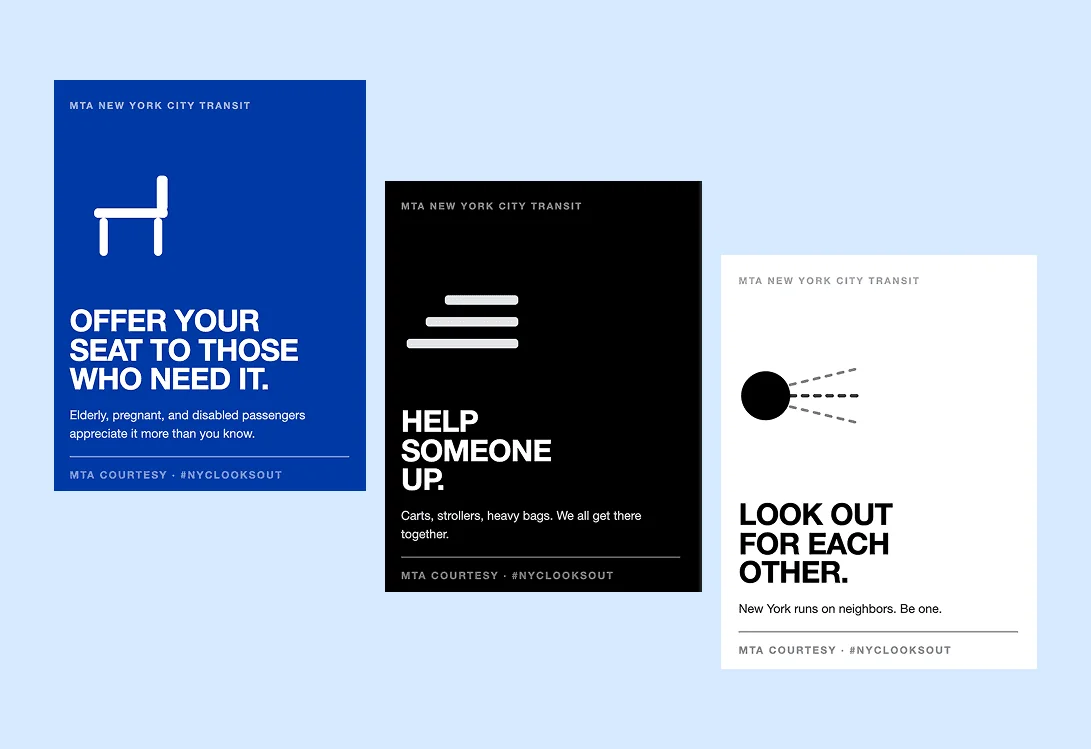
The Look Out campaign uses transit signage and public cues to encourage commuters to offer seats, make space and help older riders. It addresses the informal support networks that came up in the research.
The Look Out campaign
Where the work stands
Compass and Look Out are proposed interventions, not measured improvements in trip completion or confidence. Next steps would be to test Compass with rider–caretaker pairs and pilot the campaign in stations.
Looking back
What would make this more than a proposal
Compass and Look Out respond to different parts of the same journey, but neither has been tested for real-world impact. I'd prototype Compass with rider-caretaker pairs, paying attention to consent, control and what happens when a route changes. I'd also pilot the campaign in stations and observe behavior rather than just count impressions. This project made me think about mobility as preparation, recovery and social support, not only navigation.